SS Thistlegorm: Diving the Red Sea's Best Wreck
Diving the SS Thistlegorm: the 1941 sinking, what is still in the holds, the depth and certification you need, and how to reach her from Sharm.
Compare live offers diving sites like these — dates and prices upfront.
Find dives here →The SS Thistlegorm is the dive that made the Red Sea famous with wreck divers, and one of the very few sites anywhere that lives up to a reputation that size. She is a war grave, a cargo manifest frozen in 1941, and a genuinely spectacular dive: a 126-metre ship sitting upright in 30 metres of clear water with her holds still full of the equipment she was carrying.
What happened
The Thistlegorm was a British armed merchant ship on her fourth voyage, carrying supplies to the Eighth Army in North Africa: motorcycles, trucks, rifles, aircraft parts, rubber boots, two steam locomotives lashed to the deck. With the Suez Canal blocked, she anchored in the Strait of Gubal to wait.
On the night of 6 October 1941 two German Heinkel bombers, hunting a troop ship, found her instead. A bomb hit hold four, the ammunition it held went up, and the ship broke and sank in minutes. Nine of the crew died. The explosion threw both locomotives clear of the deck, and they still sit on the sand on either side of the wreck, the clearest evidence of how violent the sinking was.
Jacques Cousteau located and dived her in the early 1950s, then kept the position quiet. She was rediscovered by recreational divers in the early 1990s, and has been Egypt's flagship wreck ever since.
The dive
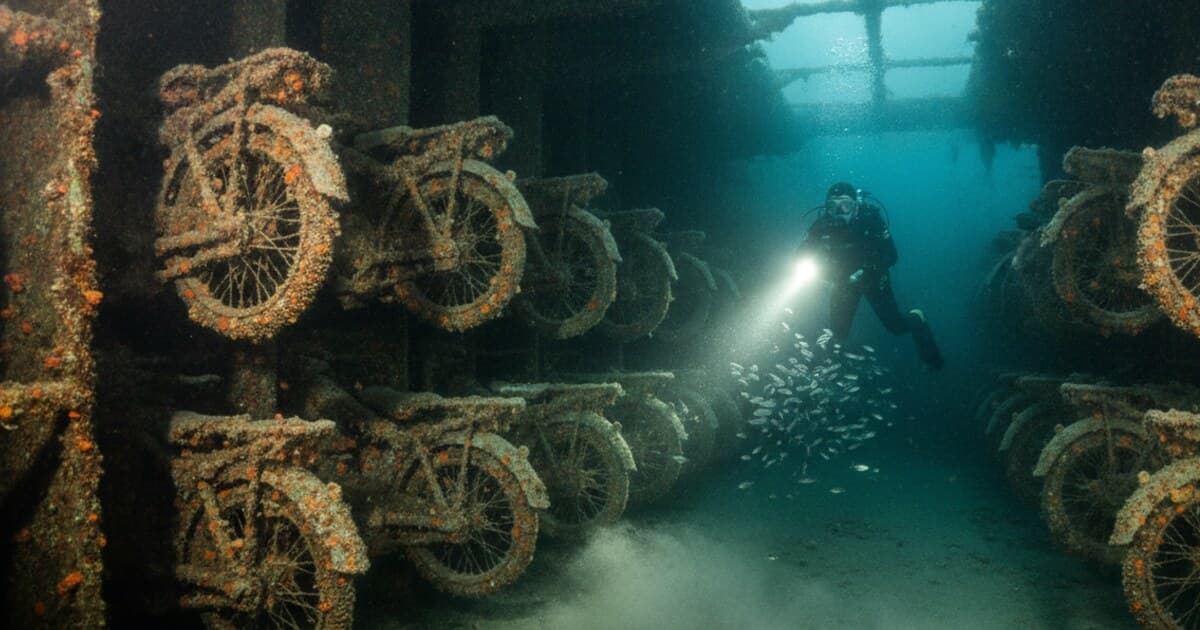
She lies upright on sand at around 30 metres, bow roughly north, with the shallowest superstructure at about 16. Typical practice is two dives: one outside to take in the scale, the bridge area and the locomotives, and one through the holds.
Hold one and two are the reason people come. Motorcycles (BSA and Norton) stacked in rows, still recognisable, still on their stands. Bedford trucks with the bikes loaded inside them. Boxes of rifles, Universal Carriers, aircraft propellers, and shelves of wellington boots that photograph better than they sound.
The deck and stern carry the anti-aircraft gun and the heavy machine gun, the ship's tanks, and the torn plating where hold four was. The locomotives sit apart on the seabed at around 30 metres, one to port and one to starboard.
Marine life has claimed all of it. Batfish hang in the lee of the superstructure, glassfish fill the interior spaces, scorpionfish sit motionless on the plating, and tuna and trevally work the outside in current.
What it demands
The Thistlegorm is not technical, but it is not casual either. Advanced Open Water is the practical requirement: the cargo sits between 20 and 28 metres and the seabed at 30.
Current is the real variable. The Strait of Gubal moves water, descents are usually down a mooring line, and a dive can go from still to strong within a tide. Penetration into the holds is straightforward where they are open and lit, but it is still overhead environment — go with a guide who knows the route, carry a torch, and do not enter anything you cannot see the way out of.
Nitrox is widely available and earns its keep here, given the depth and the repeat dives.
Getting there
From Sharm el Sheikh the run is shortest, typically leaving before dawn for two dives and back mid-afternoon. From Hurghada it is longer but routinely run. Either way it is a full day and an early start.
The best version is a liveaboard on the northern wreck route: you moor overnight and dive her at first light, before the day boats arrive and while the interior still has the light to itself. Our Egypt trip guide covers how liveaboards compare with land-based weeks.
A note on how to dive her
She is a war grave. Nine men died on board, and the cargo is not a souvenir shop — taking anything is both illegal and beneath the point of visiting. Decades of fin-kicks have also done real damage to the interior silt and the fragile cargo; good buoyancy in the holds is not showing off, it is the difference between the wreck lasting and not.
Her page in our catalogue, with depth and access detail, is here, and the wider picture is in our Egypt diving guide.
Frequently asked questions
+What is the SS Thistlegorm?
A British armed merchant ship sunk by German bombers on 6 October 1941 in the Strait of Gubal, while carrying war supplies to the Eighth Army in North Africa. She went down with her cargo aboard and now lies at around 30 metres, widely rated among the best wreck dives in the world.
+How deep is the Thistlegorm wreck?
The seabed sits at roughly 30 metres and the shallowest superstructure at around 16. Most of the interesting cargo is between 20 and 28 metres, which puts a proper visit inside Advanced Open Water limits rather than Open Water ones.
+What certification do you need to dive the Thistlegorm?
Advanced Open Water in practice. Some operators take Open Water divers around the shallower structure, but the holds and the deck cargo sit beyond 18 metres, and current plus a mooring-line descent make experience matter more than the card itself.
+What can you see inside the Thistlegorm?
Motorcycles stacked in rows, Bedford trucks, Universal Carriers, rifles, aircraft parts, wellington boots and rubber tyres — all still in the holds. Two locomotives sit on the seabed either side, blown clear by the explosion that sank her.
+Can you dive the Thistlegorm from Hurghada?
Yes, though it is a longer run than from Sharm el Sheikh. Both make it a full-day, early-start trip of two dives, and liveaboards on the northern wreck route usually include her with the luxury of diving her at dawn before the day boats arrive.
Hana writes about what you actually see down there — the wrecks, the reefs and the animals that make a particular site worth the boat ride.
Compare live offers diving sites like these — dates and prices upfront.
Find dives here →Planning the trip? Diving in Egypt →
Keep reading
Diving the Blue Hole in Gozo: the arch, the Azure Window rubble, depths, the tricky entry, and how it differs from the Blue Hole in Dahab.
Diving Ras Mohammed National Park in Egypt: Shark and Yolanda Reef, the Anemone City, park fees, when the schooling season peaks and what to expect.
Wreck diving in Malta and Gozo: the P29, Um El Faroud, Rozi and the Gozo wrecks, with depths, certification needed and which are shore dives.