Diving in Egypt: Red Sea Guide for Divers
Diving in Egypt: where to base yourself on the Red Sea, the wrecks and reefs worth the trip, seasons, costs, and which resort town suits which diver.
See live offers from local dive centres — pick a date and compare.
Scan for dives →Diving in Egypt is the reason a diver in northern Europe can leave home on Friday and be finning along a coral wall in 26°C water by Saturday morning. The Red Sea packs hard coral in genuinely good condition, warm water in every month of the year, 30-metre visibility as the ordinary state of things, and one of the world's great wrecks, at prices that make the Mediterranean look expensive.
This guide covers the diving itself: what the Red Sea is like, what you see, the wrecks, and which resort town suits which kind of diver. For the trip mechanics — liveaboard versus hotel, what a week costs, how many dives to plan and the flight-home rule — see our Egypt diving holiday guide.
What makes the Red Sea different
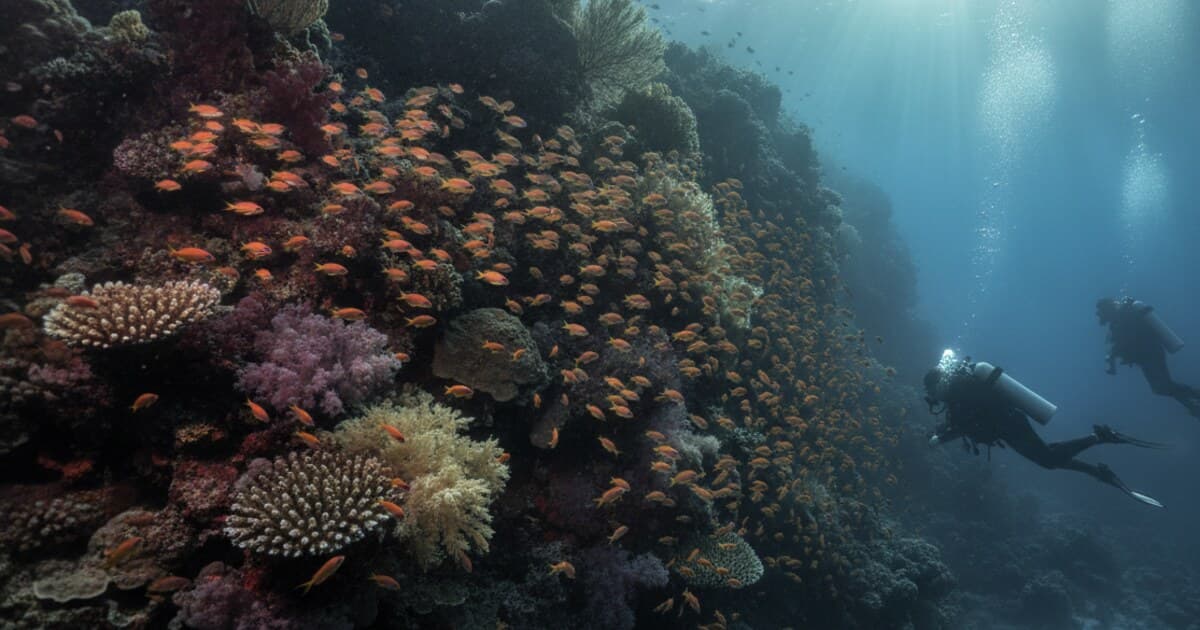
It is a young, narrow, almost enclosed sea with negligible river runoff, which is why the water is so clear and the reefs so sheer. Walls drop from the surface into the blue within a fin-kick of shore, hard corals dominate instead of the algae-covered rock of the Mediterranean, and the fish life runs at a density Europe simply does not have: anthias in clouds, napoleon wrasse, moray eels in every crack, reef sharks on the offshore sites.
Water temperature never really stops you. It bottoms out around 21-22°C in February and peaks near 30°C in August, so a 3mm suit covers most of the year and a 5mm covers the rest.
The wrecks
Egypt is a wreck destination as much as a reef one. The SS Thistlegorm, a British merchant ship sunk by German bombers in 1941, still holds its cargo of motorcycles, trucks and rifles at around 30 metres in the Strait of Gubal, regularly ranked among the best wreck dives on earth and reached by day boat from Sharm or by liveaboard. The Salem Express, the Rosalie Moller and the wrecks of Abu Nuhas add a week's worth without repeating.
The full catalogue of Egyptian dive sites we hold, with depths and access notes, is on the Egypt dive sites page.
If wrecks are the pull, our Malta guide covers the Mediterranean's answer to the same appetite, and the Zenobia in Cyprus is Europe's other headline hull.
What you actually see
The Red Sea's reputation rests on reef condition rather than rare animals, and it earns it. Hard coral gardens sit in genuinely good health, soft corals colour the walls in reds and purples, and fish density runs at a level the Mediterranean simply does not reach: anthias in orange clouds over every outcrop, napoleon wrasse cruising the drop-offs, moray eels in the cracks, bannerfish and unicornfish in numbers.
The bigger animals reward going further. Dugongs graze the seagrass beds around Marsa Mubarak near Marsa Alam. Dolphins rest daytime hours in the lagoon at Samadai. Reef sharks patrol the offshore reefs, with oceanic whitetips around Elphinstone and the Brothers through autumn, and hammerheads schooling at the remote seamounts in early summer — the honest context for that is in our shark diving guide. Turtles are common on the shallow reefs everywhere, and whale sharks are a warm-season chance rather than a plan.
None of it needs bait or cages. These are habitat dives, which is why the Red Sea keeps divers coming back rather than ticking a box.
Which town suits which diver
Hurghada: the value option and the biggest infrastructure. Easy reef diving, hundreds of centres competing on price, and day boats to Abu Nuhas. Best for beginners, courses and divers who want maximum dives per euro.
Sharm el Sheikh: the marquee sites. Ras Mohammed National Park, the Straits of Tiran, and the shortest run to the Thistlegorm. Best for certified divers who want the famous dives.
Dahab: the antidote to resort diving. Shore entries, a bohemian town, the Blue Hole and the Canyon, and Egypt's cheapest diving. Best for independent divers and long stays.
Marsa Alam and the south: dugongs at Marsa Mubarak, dolphin house at Samadai, and the gateway to the southern offshore reefs. Quieter, newer, increasingly the choice of repeat visitors.
Seasons, honestly
| Period | Water | What it means |
|---|---|---|
| Dec-Feb | 21-23°C | 5mm suit; cheapest prices, cool evenings |
| Mar-May | 23-26°C | The sweet spot: warm, calm, uncrowded |
| Jun-Aug | 27-30°C | Hottest above water; 3mm or shorty |
| Sep-Nov | 26-28°C | Warm water, thinning crowds, best all-round |
Wind is the variable that decides days out. The northerlies that blow through spring can close offshore sites while the sheltered reefs carry on, which is one reason a week beats a long weekend here.
Costs and logistics
Guided dives run roughly €30-45, two-dive day boats €60-90 with lunch, and a full Open Water course €350-450. Liveaboards, the way to reach the Brothers, Daedalus and Elphinstone, typically cost €900-1,600 for a week with all diving and full board. Flights from most of Europe run four to five hours into Hurghada, Sharm or Marsa Alam.
Two practical notes. Nitrox is cheap and widely available here, and it earns its keep on repetitive deep reef days. And plan the flight home against your last dive: our flying after diving guide covers the 18-hour rule that catches people out on Friday departures.
Booking dives in Egypt
Diving Scanner is opening across the Mediterranean and the Red Sea — Egypt is on the expansion map, and bookable offers start in Cyprus today. As Egyptian centres join, their trips appear in the same search: prices upfront, a small deposit online, and the balance paid directly to the centre. Centres are reviewed before listing, and ratings come only from divers who completed a booking.
Frequently asked questions
+Is Egypt good for scuba diving?
It is the best-value world-class diving within four to five hours of Europe. The Red Sea has hard coral walls in excellent condition, water between 22 and 30°C year-round, visibility that regularly passes 30 metres, and the SS Thistlegorm, widely rated among the finest wreck dives anywhere.
+Where should I dive in Egypt?
Hurghada for value and easy reef days, Sharm el Sheikh for Ras Mohammed and the Straits of Tiran, Dahab for laid-back shore diving and the Blue Hole, and Marsa Alam for dugongs and southern reefs. Liveaboards reach the offshore sites the day boats cannot.
+When is the best time to dive the Red Sea?
Diving runs all year. March to May and September to November are the sweet spots — water in the mid-20s, comfortable air temperatures and thinner crowds. Summer is hot above water and warmest below; winter water drops to 21-22°C, which is a 5mm suit rather than a stop.
+How much does diving in Egypt cost?
Among the cheapest quality diving in the world: roughly €30-45 per guided dive, €60-90 for a two-dive day boat with lunch, and €350-450 for an Open Water course. Week-long liveaboards commonly run €900-1,600 including all diving and full board.
+What can you see diving in Egypt?
Hard and soft coral in genuinely good condition, anthias in clouds, napoleon wrasse, moray eels, turtles and reef sharks on the offshore sites. Dugongs graze the seagrass around Marsa Alam, dolphins rest at Samadai, and oceanic whitetips patrol the southern reefs in autumn. Whale sharks are a warm-season chance rather than a plan.
+Is Egypt better than the Maldives or the Caribbean for diving?
For a European diver, usually yes on value and access: four to five hours of flying, a fraction of the cost, and reef health that holds up against either. The Maldives beats it for big pelagics and the Caribbean for warm shallow reef, but neither is a long-weekend destination from Europe.
+Do I need to be an experienced diver for the Red Sea?
No. Hurghada and Dahab have gentle, shallow reefs ideal for beginners and courses. The famous sites are a different matter — the Thistlegorm sits at 30 metres and the offshore reefs carry current, so those want an Advanced certification and some recent dives.
Elena covers dive destinations around the Mediterranean — where to go, when the water is worth it, and what a week of diving actually costs.
See live offers from local dive centres — pick a date and compare.
Scan for dives →Planning the trip? Diving in Egypt →
Keep reading
Plan your Great Barrier Reef dive trip: best sites, best season, realistic costs and how to choose between day trips and liveaboards.
A practical guide to diving in Bali: the best sites from Tulamben to Nusa Penida, seasonal timing, realistic costs and how to find a dive centre.
Koh Tao diving: 25+ sites, PADI Open Water from $290, and warm water year-round. This guide covers the best sites, seasons, and real costs.